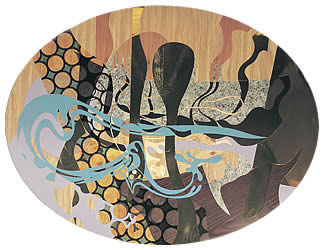
Torluemke's collages of preprinted contact paper offer a wry commentary on imitation surfaces that fail to convince. Juxtaposing several different designs and textures in jagged patterns, they resemble jigsaw puzzles that don't add up to a whole picture. In one of the three circular panels that make up Eclipse, for example, fake wood grain dashes with checkerboards and flower patterns, suggesting that all designs are arbitrary, meaningless choices. In the central panel, the wood-grain paper is cut to suggest legs and feet while to their Ieft is a cloud pattern. Together they suggest travel—and subvert the usual symbolism of the sky by equating it with the pedestrian.
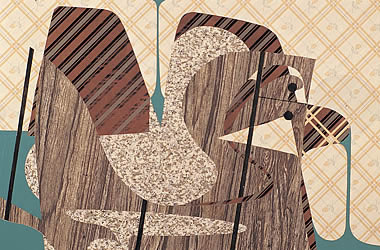
Death of an Elephant, 2001, 11 x 17", contact paper collage
Torluemke's upbringing may have made him suspicious of easy meanings. As a child, he told me, he spent a lot of time with an uncle who couldn't hear or speak, and they drew together as a form of communication, depicting activities they were planning. His parents fought frequently; after their divorce, his alcoholic father was often homeless, and Torluemke would sometimes take him in. For the artist, contact paper recalls the "nasty, peeling" drawer liners in the "yucky places" where his father sometimes stayed.
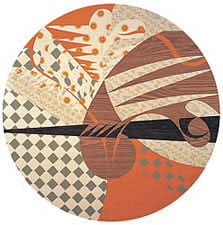
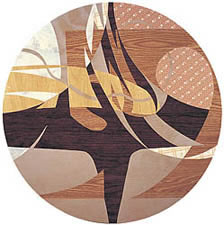
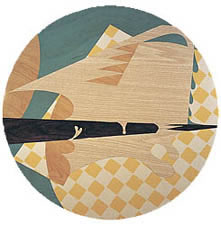
Eclipse, 2001, three panles, 2.5' dia. each, contact paper collage
I considered Torluemke's restraint, his lack of obvious commentary,
to be a strength—and was startled to learn that the events of September
11 influenced much of this work. The attacks suddenly made them seem even more
appropriate: among other things, Torluemke thought that the patterns of the
contact paper, which he connects with 50s suburbanization, "would be nostalgic
and somehow warming in a way that would have lent some hope and maybe counteract
aggression." On the other hand, these collages present abstracted views
of planes crashing into towers, while the arcs in EcIipse suggest. "the
whole idea of the eclipse."
I didn't see any of this, which was fine with Torluemke. The gray "elephant"
at the bottom of Death of an Elephant is distanced from any representational
connection by its wood-grain pattern—and it's certainly not obvious -that
the elephant represents America attacked. One does see forms and textures interlocked,
as in a struggle, and when the stripes of one pattern flow into the stripes
of the plaid above it, the designs are so different that this "link" becomes a joke on false connections. While the patterns do convey warmth, the
collisions between them suggest a hopelessly divided world.
By Fred Camper, (excerpted from) The Reader, November 9, 2001